
Two Years Since July Mass Uprising: The Promise Must Not Fade
Published: 05 August 2026, 2:10:36
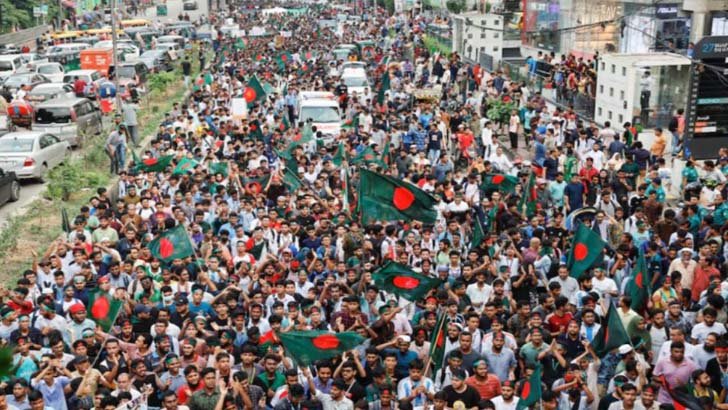
Students against discrimination march on the road as they join in a rally to mark one month of the end of Awami League regime, at the University of Dhaka, in Dhaka, Bangladesh, September 5, 2024. Photo : Collected
Today (5 August) marks two years since the July Mass Uprising, a defining moment in Bangladesh’s contemporary history. What began as a movement against perceived discrimination in the government job quota system soon grew into a nationwide demand for accountability, justice and democratic governance. The subsequent fall of the Sheikh Hasina government ended more than 15 years of uninterrupted rule and ushered in a new political chapter.
The transition that followed was unprecedented. An interim government led by Dr Muhammad Yunus guided the country through a critical period before parliamentary elections were held earlier this year. The Bangladesh Nationalist Party (BNP) returned to power with a commanding majority, while Bangladesh Jamaat-e-Islami emerged as the main opposition in parliament.
Political change, however, should never be mistaken for the fulfilment of public aspirations. The July Mass Uprising was not merely about replacing one government with another. It reflected a broader desire for accountable institutions, the rule of law, greater transparency and equal treatment of citizens. Those aspirations remain as relevant today as they were two years ago.
The responsibility for meeting those expectations now rests with the elected government. Its success will not be measured solely by parliamentary strength or political stability, but by its willingness to strengthen democratic institutions, uphold constitutional principles and ensure that public offices serve the people rather than partisan interests.
Restoring confidence in state institutions must remain a national priority. An independent judiciary, professional law enforcement agencies, an impartial civil service and effective oversight mechanisms are essential pillars of any healthy democracy. Equally important is protecting the space for constructive political opposition, independent media and civil society, all of which contribute to democratic resilience.
Economic recovery is another pressing challenge. Citizens expect relief from inflation, greater employment opportunities and policies that encourage investment while protecting the interests of ordinary people. Bangladesh has demonstrated remarkable economic resilience over the years, but sustaining growth requires sound governance, policy consistency and investor confidence. Political stability can facilitate progress, but it cannot substitute for effective economic management.
The government has also emphasised restoring law and order and strengthening Bangladesh’s diplomatic engagement with international partners. These objectives deserve support. A secure environment encourages investment, protects citizens and reinforces public confidence. Likewise, a balanced and pragmatic foreign policy is essential in an increasingly complex geopolitical landscape.
Yet history teaches that the success of transformative movements is determined not by the moment of victory but by what follows. Public expectations inevitably rise after political change. If institutions remain weak, reforms stall or governance fails to improve, disappointment can erode the optimism that once united the nation.
As Bangladesh observes the second anniversary of the July Mass Uprising, the occasion should be one of thoughtful reflection rather than political triumphalism. The sacrifices and aspirations associated with that movement belong to the nation as a whole, not to any single political party or government.
The promise of July will ultimately be judged not by commemorative events or political speeches, but by whether Bangladesh succeeds in building a more accountable, inclusive and democratic state. That remains the unfinished task before the nation.
Two years on, the opportunity created by the July Mass Uprising is still alive. Preserving it requires responsible leadership, strong institutions and an unwavering commitment to democratic values. Those are the foundations upon which Bangladesh’s future should be built.