
Bangladesh, South Korea ink landmark CEPA to boost bilateral trade
Published: 04 August 2026, 3:25:40
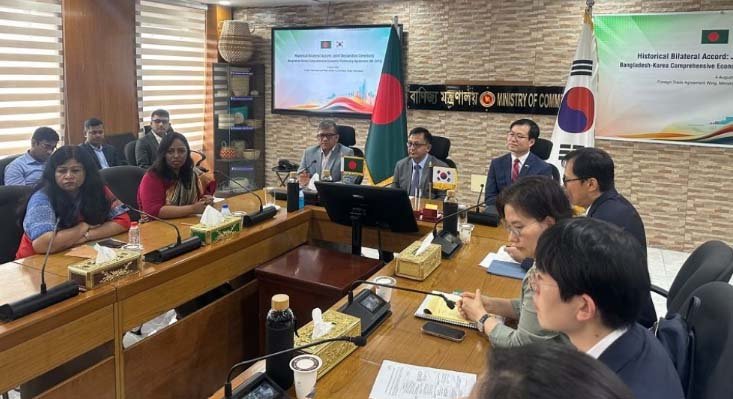
Photo: Courtesy
Bangladesh and South Korea on Tuesday signed the long-awaited Comprehensive Economic Partnership Agreement (CEPA), marking a major milestone in bilateral trade relations and paving the way for preferential tariff access for 97% of Bangladeshi goods and services in the South Korean market.
The agreement was signed at the Ministry of Commerce in Dhaka, followed by a press briefing after the CEPA Negotiation Conclusion Ceremony.
Commerce Minister Khandaker Abdul Muqtadir described the deal as a significant achievement for the government, saying Bangladesh had successfully concluded its first CEPA with one of the world’s largest economies within five months of taking office.
“We have been able to sign a trade agreement with one of the world’s major economies in the shortest possible time. This is the first CEPA concluded by our government within five months,” the minister said.
97% of Bangladeshi Exports to Enjoy Preferential Tariffs
Under the agreement, 97% of Bangladeshi products and services will receive preferential tariff treatment in the South Korean market, while 87% of South Korean exports will enjoy similar benefits in Bangladesh.
The commerce minister said South Korea, with an economy worth around US$2 trillion, would become a major strategic trading partner for Bangladesh.
He said Bangladesh’s key export items—including ready-made garments (RMG), leather and leather products, jute and jute goods—would receive preferential market access under the agreement.
In return, Bangladesh will benefit from easier imports of South Korean agricultural products, plastics and industrial spare parts.
CEPA to Support Investment and Economic Growth
Muqtadir said the government aims to transform Bangladesh into a US$1 trillion economy by 2034, which would require sustaining annual economic growth of around 8%.
“To achieve that goal, we need greater foreign direct investment (FDI). Agreements such as this are intended to attract more overseas investment into Bangladesh,” he said.
South Korea Eyes Stronger Investment, Technology Cooperation
South Korean Trade Minister Yeo Han-koo said the two countries have enjoyed a long-standing economic relationship that began with the textile sector 56 years ago.
However, he noted that the global economy is becoming increasingly diversified, requiring both countries to expand cooperation beyond traditional trade.
“We hope Bangladesh’s new government will further strengthen the country’s economy. We are keen to deepen cooperation in technology and supply chains,” he said.
Yeo added that the CEPA would encourage more South Korean companies to invest in Bangladesh by creating a more favourable business environment.
Bilateral Trade Continues to Grow
Although bilateral trade remains relatively modest, it has expanded steadily in recent years.
According to official data, total trade between Bangladesh and South Korea currently stands at approximately US$1.39 billion.
Bangladesh exports goods worth around US$491.73 million annually to South Korea, while imports from South Korea total approximately US$902.90 million, leaving Bangladesh with a trade deficit of about US$411 million.
Bangladesh’s principal exports to South Korea include knitwear and woven garments, home textiles, leather and leather products, footwear, pharmaceuticals, jute and jute products, frozen foods and ceramic products.
Major imports from South Korea include iron and steel, machinery and industrial equipment, electrical appliances, plastics and plastic products, chemicals, and paper and paper products.
The CEPA is expected to strengthen bilateral trade, diversify exports, boost investment and enhance long-term economic cooperation between the two countries.