Education, not concrete or steel, will build Bangladesh-China bridge: Milon
Published: 27 May 2026, 1:46:30
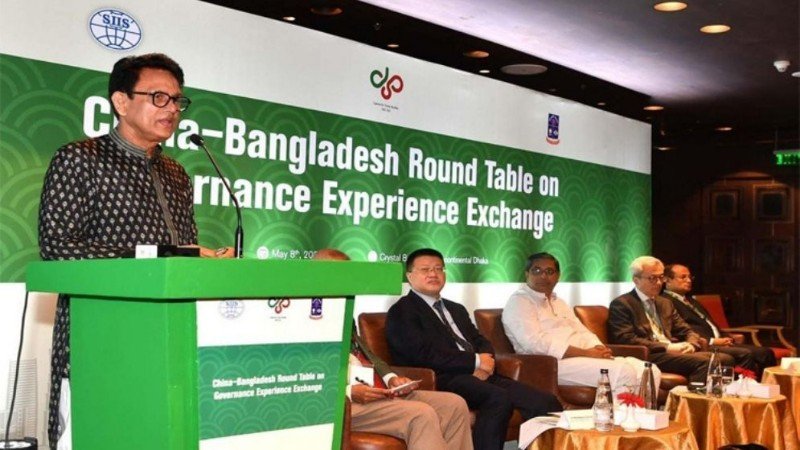
Education and Primary and Mass Education Minister ANM Ehsanul Hoque Milon on Friday said education, not concrete or steel, would be the main foundation for building a stronger bridge between Bangladesh and China as the two countries deepen cooperation in higher education, governance and development.
“Education will be the construction material to build a bridge between Bangladesh and China,” he said while addressing the opening session of the “China-Bangladesh Round Table on Governance Experience Exchange” at a city hotel in the morning.
The day-long conference was organised by the Centre for China Studies of Dhaka University in collaboration with the Shanghai Institutes for International Studies (SIIS).
Highlighting the growing strategic partnership between the two countries, the minister said Bangladesh and China were strengthening relations through academic cooperation, research and institutional exchanges.
“What would be the construction materials to build a bridge between China and Bangladesh? Is it concrete, cement or rod? No, it is education,” he said.
Milon said Dhaka University (DU) recently signed two memorandums of understanding (MoUs) with Chinese universities to expand cooperation in higher education and research.
“There’s a reason behind the strategic relation between Dhaka University and China. We are having MoUs one after another to improve our strategic relationship with China,” he added.
Milon stressed the need to transform Bangladesh’s huge population into skilled human resources through quality education and technical training.
“Bangladesh is one of the most densely populated countries in the world. We must convert this population into human capital. So, this is our duty,” he said.
Referring to the government’s education agenda, Milon said the government led by Tarique Rahman was planning major investments in the sector with a focus on knowledge exchange, skills development and Technical and Vocational Education and Training.
He said Chinese expertise in vocational education and industrial development could help Bangladesh build a productive workforce similar to China’s development experience.
The minister also expressed optimism about future cooperation between the two countries. “The relation between China and Bangladesh will be very prosperous and good,” he added.
Chinese Ambassador to Bangladesh Yao Wen said Beijing considered the Bangladesh Nationalist Party (BNP) an important partner in governance cooperation and state management.
“The Communist Party of China and the BNP are both ruling parties, and the exchange of state governance experience between the two is now embracing unprecedented opportunities,” he said.
The ambassador said bilateral relations had expanded significantly through political exchanges, education, infrastructure and economic cooperation.
He noted that personnel exchanges between the two countries were increasing rapidly, with the Chinese Embassy issuing over 32,000 visas so far this year.
Officials expect the number to surpass 100,000 by the end of the year, supported by 45 weekly round-trip flights between Dhaka and different Chinese cities, he added.
Yao Wen said China was also expanding educational cooperation with Bangladesh through the establishment of new Confucius Institutes at Rajshahi University and Chittagong University.
He said four Chinese companies recently invested nearly US$100 million in Bangladesh, creating around 10,000 jobs.
The envoy also mentioned major ongoing cooperation projects, including the Teesta River Comprehensive Management and Restoration Project and the Mongla Port upgrade.
“China remains a trustworthy and reliable partner for Bangladesh,” he said, adding that Beijing would continue supporting Bangladesh’s economic diversification and development efforts.
The ambassador also reaffirmed China’s support for Bangladesh’s candidature for the presidency of the 31st United Nations General Assembly.
Dhaka University Vice-Chancellor (VC) Professor Dr ABM Obaidul Islam, SIIS President Dr Chen Dongxiao and State Minister for Local Government, Rural Development and Cooperatives Mir Shahe Alam, among others, addressed the event.
The conference featured several sessions on international affairs, artificial intelligence and governance, and river and urban transportation governance, attended by academics, diplomats and policy experts from both countries.