
Migrant death toll rises to 67 after Spain border rush
Published: 01 August 2026, 10:14:55
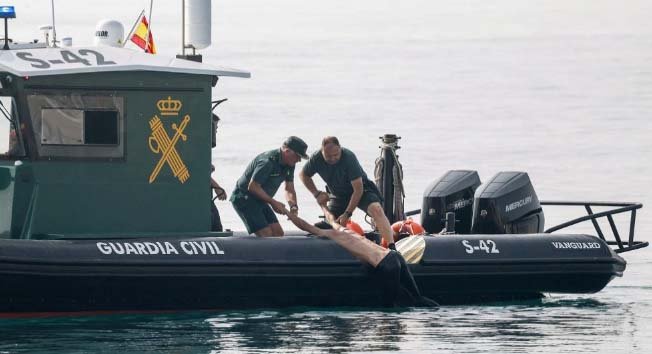
Photo: Collected
The death toll from the abrupt surge in migrant influx into Ceuta, a Spanish exclave in North Africa, has risen to 67, Spain’s Interior Minister Fernando Grande-Marlaska told reporters on Saturday.
Most had died by drowning in the sea and by stampede in their frantic attempts to cross into Europe and seek a decent job.
By Saturday morning, all the migrants, estimated at around 60,000, had left after seeing the prospects of Europe entry as dismal, said Grande-Marlaska. Many also lost hope after they had to wander the streets with nothing to eat and with little welcome for two-three days in Ceuta.
The migrant surge had begun suddenly on Thursday morning, overwhelming border security at the small Spanish exclave and prompting panic across Europe.
As calm returned overnight on Saturday, Spanish police began installing a 500-metre (1,640-foot) floating barrier off its border with Morocco.
Civil Guard police started laying the new barrier at 7:50am (0550 GMT) on the Tarajal breakwater, one of the main points used by people trying to enter the tiny Spanish territory, the government said in a statement.
The pneumatic barrier, alongside a line of anchored naval buoys, is designed to stand 30 to 70 centimetres (12-28 inches) above water and extend as much as one metre below the surface, it added, while a channel between the barriers will allow Civil Guard vessels to patrol the area.
Earlier, at least 67 bodies have been recovered on the Spanish side of the frontier, officials said.
The unprecedented surge prompted an international crisis for Spain and drew questions as well as criticisms over the country’s relatively relaxed immigration policies.
Spanish government termed the surge a “violation of territorial integrity,” but still faced criticisms from some European counterparts.
Furthermore, Italy temporarily restored some border controls on travel from Spain, and France ordered extra checks along its border.
Spain blasted the moves as “selfish,” and also countered allegations levelled against its migration policies.
Spanish officials said they would try to expel those who entered illegally into Ceuta as quickly as possible, despite a recent ruling by Spain’s Supreme Court. The apex court has ruled that migrants arriving by sea cannot be returned to Morocco.
However, existing regulations meant the new migrants through sea could only stay in Ceuta and would face border checks and restrictions for forward travel.
By default, third-country nationals in Ceuta do not have free movement to mainland Spain or the rest of the Schengen area, and identity and visa checks are required.
Spanish Prime Minister Pedro Sanchez blamed the influx on misinformation and misinterpretation spread by people traffickers following the Supreme Court ruling.
Reuters spoke to 16-year-old Moroccan Ayoub El Abyad, who said he and his cousin decided to make the 12-hour journey toward Ceuta after watching Instagram videos of other migrants crossing.
“Migration is about improving our lives. We agreed we would try the idea of crossing and trust in God,” El Abyad told the news agency from the Moroccan side of the border.
The videos circulated as reports spread on social media about the Spanish Supreme Court ruling, leading many young Moroccans to see an opportunity to cross.
Broader economic frustrations are also a factor: Official figures cited by Reuters show that one in four Moroccans ages 15 to 24 are not in education, employment or training. Calm seas at this time of year also make swimming a more viable option.
Morocco does not recognize Spanish sovereignty over Ceuta or Melilla, describing the centuries-old Spanish exclaves as “occupied,” leading some analysts to question whether Moroccan authorities deliberately did little to prevent the crossings.
In contrast to most of Europe, Spain has adopted a more open stance on migrants, introducing a programme to grant residency to more than half a million undocumented people.
But it has rejected suggestions that the regularisation scheme had encouraged the rush into Ceuta, saying applicants must prove residence in Spain before 1 January 2026, and five continuous months of residence when applying.