550 receive training under JICA project
Published: 14 May 2026, 6:27:20
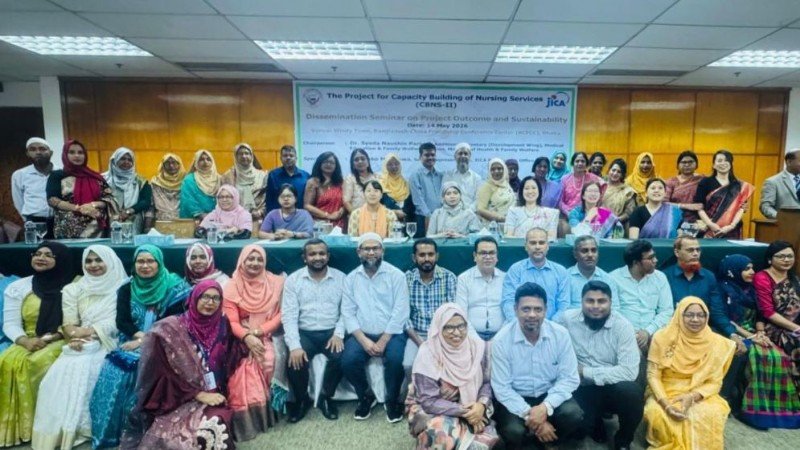
The Ministry of Health and Family Welfare with support from the Japan International Cooperation Agency (JICA) organised a seminar on Thursday at Bangladesh-China Friendship Conference Center in Sher-e-Bangla Nagar area of the capital.
The seminar focused on “The Project for Capacity Building of Nursing Services Phase 2 (CBNS-II)”, a technical cooperation initiative of the ministry and the multilateral donor agency, said a press release.
The seminar highlighted the activities, achievements, and lessons learned from the CBNS-II Project and introduced the “CBNS Model” as a sustainable framework for strengthening nursing education and clinical nursing practice in Bangladesh.
The event also served as a platform for knowledge sharing, collaboration, and discussion among stakeholders involved in nursing human resource development.
Implemented from 2022 to 2026, the CBNS-II Project has focused on strengthening the implementation systems for nursing education and clinical nursing practice through collaboration with eight divisional-level public nursing colleges, collaborative hospitals, and relevant institutions, including the Directorate General of Nursing and Midwifery, Bangladesh Nursing and Midwifery Council, and the MOHFW.
The ultimate goal is to provide better health care services to the patients efficiently.
Dr Syeda Naushin Parnini, additional secretary of the Medical Education and Family Welfare Division, said, “JICA has long been a trusted development partner of Bangladesh. The JICA CBNS-II Project implemented a unique initiative through a cascade model involving master trainers and clinical nurse teachers to strengthen the capacity and professional development of nursing professionals.”
Morikawa Yuko, senior representative of JICA, said, “An important objective of today’s seminar is to share these achievements and lessons learned more widely among the practitioners and policymakers gathered here so that, with both a clear model and capable human resources now in place, these efforts can expand beyond the project sites.”
As part of the project activities, CBNS-II carried out various capacity-strengthening initiatives in areas such as faculty development, training for clinical nurse teachers, nursing administration and management, and mutual learning among institutions.
Under the project, a total of 64 master trainers and 486 clinical nurse teachers got training. Based on the experiences and lessons learned throughout project implementation, the project developed the “CBNS Model,” a framework designed to support sustainable nursing capacity strengthening in Bangladesh.
The model consists of four key components: capacity development and localisation through cascade training; training methodologies that enhance participants’ learning experiences; strengthened collaboration between nursing colleges and hospitals; and standardisation and quality improvement through inter-institutional mutual learning.
These components, along with the project’s achievements and practical experiences, were presented and discussed during the seminar.
The seminar brought together representatives from nursing colleges, medical college hospitals, professional organisations, government institutions, and development partners to exchange experiences and discuss future directions for strengthening nursing human resources in Bangladesh.
The event also emphasised the importance of continued networking, collaboration, and knowledge sharing among relevant institutions.