
Filth at the front door: A health centre drowning in its own neighbourhood’s waste
Published: 11 June 2026, 7:21:33
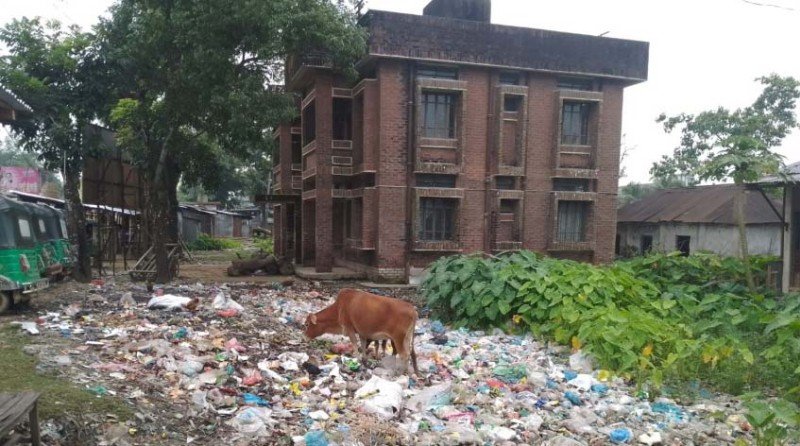
Every day, hundreds of ill men, women and children make their way to the Prithimpassa Family Welfare Centre in Robirbazar of Moulvibazar’s Kulaura upazila, seeking relief and recovery. What greets them instead is a towering mound of rotting garbage, festering just steps from the entrance.
Rahela Begum had travelled from Muroichara, in Kulaura, with hopes of getting better, but her condition deteriorated instead.
“Not from my illness alone,” she said, “but from the overwhelming stench of garbage piled high beside the very building where I had gone for care.”
On a recent visit, this correspondent observed waste being dumped freely in an open space adjacent to the centre — plastic, polythene, rotting food from nearby hotels and other refuse forming a large, foul-smelling mound that locals say has been growing unchecked for years.
Husna Begum, a patient from Muroichara who had also come for a routine check-up, said the stench made it unbearable even to wait outside.
“We are already unwell when we come here. The smell makes us feel even worse. How can we get better in such an environment?” she asked.
Kamal Miah, who had accompanied his ailing mother from a border-area village, was equally frustrated. “We travel a long distance to get treatment here. But when we arrive, the filth makes us question whether coming is doing more harm than good,” he said.
“The authorities have a duty to ensure a clean and safe environment for patients.”
A problem years in the making
Robirbazar serves as the commercial hub for six unions in the southern part of the upazila, drawing thousands of buyers and sellers daily.
The family welfare centre, meanwhile, provides healthcare to hundreds of patients from across the region, including those from border areas. Yet locals say the facility has seen little to no infrastructural development in years.
The root of the crisis, residents argue, is the absence of a clearly demarcated boundary for the government land on which the centre stands. Without defined limits, encroachment attempts have multiplied, and the open space has become an informal dumping ground for market waste, partly because Robirbazar has no designated waste disposal site.
“We have repeatedly demanded that the administration define the boundaries of the health centre, build a boundary wall, prevent illegal encroachment and remove the garbage,” said one local resident.
“No effective action has been taken to this day.”
Sadek Hosain, another resident, said the situation had deteriorated steadily as no authority had stepped in to claim responsibility.
Hasan Al Mahmud Raju, chairman of the Robirbazar Poor Foundation, said garbage had been dumped freely beside the health centre for six to seven years, with no permanent solution despite the problem being widely known.
“Earlier, the volume was lower. It has increased significantly in recent times,” he said.
“The stench has made it difficult even to stand nearby, and it is the patients and their relatives who are suffering most.”
He added that water shortages had historically plagued the centre, and that the deteriorating sanitary conditions now posed fresh risks for the very people seeking care there.
Masuk Ahmed, president of the Robirbazar Traders’ Association, said the association had made repeated efforts to curb illegal dumping, including public awareness campaigns through loudspeaker announcements, and had personally warned traders and local residents.
A section of people, he said, continued to litter regardless.
Masuk, who has been associated with the market committee for 35 years, acknowledged structural constraints.
“The market has a developed drainage system, but the designated waste disposal site is some distance away. Adequate allocation for waste management would go a long way toward resolving this,” he said.
Identifying those responsible had also proved difficult: most of the market’s CCTV cameras are currently non-functional.
“If we receive sufficient funds to reactivate the system, it will be much easier to hold people accountable,” he added.
He said the Moulvibazar-2 lawmaker Shawkatul Islam Shaku had been approached for financial support.
Shirina Khatun, the centre’s deputy assistant community medical officer, confirmed the situation but was clear that centre staff bore no responsibility for the dumping.
“People from the market are throwing garbage here. I reported the matter to the president of the traders’ association, but no effective action has been taken,” she said.
Jerin Akhter, acting upazila health and family planning officer at Kulaura Upazila Health Complex, said initiatives had been taken at various times to address the centre’s longstanding problems.
“The civil surgeon had visited, held meetings with the traders’ association and written to relevant authorities. The local MP had also visited and spoken with traders. Yet the situation had remained unresolved,” she said.
“I have been posted here for nearly two years. Despite my efforts, the problem has not been resolved,” she said, adding that she would write to the concerned authorities once more seeking a swift solution.