
National Eidgah sees Prime Minister at Eid prayers after 35 years
Published: 21 March 2026, 2:43:30
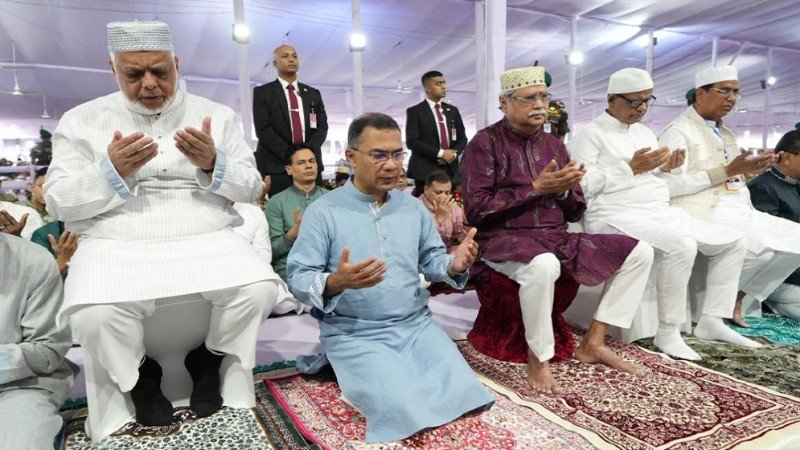
The main Eid-ul-Fitr congregation was held at the National Eidgah on Saturday morning, with both the President and Prime Minister participating together.
The congregation, held at 8:30am, saw President Mohammad Shahabuddin and Prime Minister Tarique Rahman offering prayers alongside thousands of worshippers.
With this, Tarique Rahman became the first male prime minister in 35 years to attend the main Eid congregation at the National Eidgah. The last male prime minister to do so was Kazi Zafar Ahmed in 1989–90. For more than three decades since then, the post had been held by female prime ministers.
The joint participation of the President and Prime Minister has been viewed as a politically and institutionally significant event.
Earlier, former caretaker government chief adviser Fakhruddin Ahmed and Nobel laureate Muhammad Yunus had joined Eid congregations at the venue in their respective roles, but no prime minister had attended since 1990.
The Eid prayers were led by Mufti Mohammad Abdul Malek, khatib of the Baitul Mukarram National Mosque. Following the two rakats of wajib prayer, a khutba was delivered and special prayers were offered for the peace and prosperity of the nation.
From early morning, large crowds of devotees gathered at the Eidgah from different parts of the capital. Entry began nearly two hours before the prayer under tight security.
On-the-spot observations showed long queues stretching from Paltan intersection to the front of the National Press Club, while steady streams of worshippers also arrived from Matsya Bhaban and the University of Dhaka area.
The Eidgah ground was prepared under the supervision of the Dhaka South City Corporation. Members of the cabinet, lawmakers, judges, political leaders, senior government officials and diplomats from various countries joined the congregation.
Separate arrangements were made for female worshippers, including designated entry points and prayer spaces. Medical teams and adequate ablution facilities were also ensured.
In total, arrangements were made for around 35,000 worshippers, including approximately 3,500 women.