Manifestos must guarantee equal rights for persons with disabilities: TIB
Published: 05 February 2026, 2:57:39
Political parties must make their concrete commitment to the rights of persons with disabilities in their election manifestos and governance plans, Transparency International Bangladesh (TIB) Executive Director Dr Iftekharuzzaman said on Thursday.
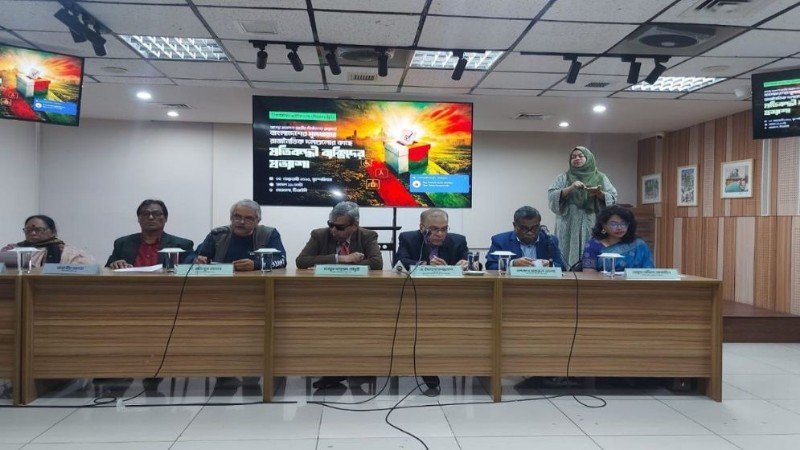
He made the remarks at a press conference titled “Expectations of Persons with Disabilities from Mainstream Political Parties” ahead of the 13th National Parliamentary Election and Referendum 2026. The event was organised by Disability Rights Watch (DRW) at the TIB office in Dhaka’s Dhanmondi.
Dr Iftekharuzzaman said discussions on a “level playing field” in elections usually focus on political parties and candidates, but the concept must also apply to voters, including persons with disabilities and other marginalised groups.
“If voters do not have equal access and a safe environment to cast their ballots, the election cannot be called inclusive or fair,” he said. “Ensuring equal participation for persons with disabilities is not charity; it is a fundamental democratic right.”
He urged the Election Commission and all relevant authorities, including the administration and security agencies, to take special measures so that persons with disabilities can vote safely and without obstacles.
These measures include accessible transport, assistance for voters who need support, and voter-friendly arrangements at polling centres.
The TIB chief said many countries have systems where election officials collect votes from the homes of people with severe mobility limitations. While such arrangements may not be immediately feasible in Bangladesh, authorities must at least ensure that disabled voters can exercise their rights without hardship.
Turning to political parties, he warned that election manifestos in Bangladesh have often remained “paper promises” with little implementation. He urged parties forming the next government to treat disability rights as a priority, regardless of whether the issue is explicitly mentioned in their manifestos.
“The new government will carry the responsibility of building an inclusive and discrimination-free state, especially in the context of the recent anti-discrimination movement,” he said. “Persons with disabilities were part of that struggle. They cannot be ignored once power changes hands.”
He also called on both ruling and opposition parties, as well as those without parliamentary representation, to work collectively to advance the rights of persons with disabilities and other marginalised communities.
Dr Iftekharuzzaman stressed the need for a specific national action plan to ensure equal rights for persons with disabilities, in line with both domestic commitments and international obligations.
Highlighting accessibility issues, he said many public buildings in Bangladesh remain inaccessible to people with mobility challenges, despite accessibility being a fundamental right.
He urged authorities to address the issue urgently, noting that disability can affect anyone at any time.
“Every voter, disabled or not, has equal rights. If we truly want to present ourselves as a modern, inclusive nation, these rights must be guaranteed in practice,” he said.
The press conference was also addressed by DRW President Mansur Ahmed Chowdhury, who outlined a set of demands to be placed before political parties and the next government.
The press conference was attended by Mansur Ahmed Chowdhury, president of Disability Rights Watch (DRW) and chairperson of the Board of Trustees at Transparency International Bangladesh (TIB), Khandaker Jahurul Alam, member secretary of DRW and executive director of the Centre for Services and Information on Disability (CSID), Amrita Regina Rosario, country director of Sightsavers Bangladesh; Mohua Paul, chairperson of Access Bangladesh Foundation, Dr Nafisur Rahman, disability inclusion expert and Eisenhower Fellow, Md Jahangir Alam of DRW, youth activist Md Abdullah, a person with speech and hearing disabilities, and Dr Iftekharuzzaman, executive director of TIB, among others.