Japan pledges support for sustainable solution to Rohingya response
Published: 10 December 2025, 2:22:57

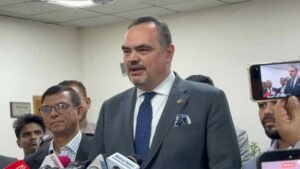
Working closely with international partners such as UNDP, Japan remains committed to making contributions towards a sustainable solution to the Rohingya response, said Charge d’Affaires ad interim of Japan to Bangladesh Takahashi Naoki.
“I am hopeful that this comprehensive solid waste management facility will help improve the lives of both Rohingya refugees and host communities,” said the diplomat.
Since the beginning of the emergency in August 2017, Japan has supported the Rohingya refugee response in Bangladesh, contributing over US$240 million, said UNDP in a media release on Wednesday.
The Refugee Relief and Repatriation Commissioner (RRRC), in partnership with the United Nations Development Programme (UNDP) and the Embassy of Japan, inaugurated the expanded sanitary landfill facility at Camp 20 Extension in Ukhiya, Cox’s Bazar recently.
The expansion marks a significant milestone in strengthening safe, sustainable and system-based solid waste management for both Rohingya refugees and the surrounding host communities.
The upgraded facility is designed to handle an additional 60,000 m³ of non-recyclable waste, ensuring uninterrupted waste disposal for the next seven to eight years.
This will help prevent environmental contamination, reduce public health risks, and improve living conditions across 26 camps, where nearly 140 tonnes of waste are generated daily.
The landfill serves as the backbone of a wider waste management system developed by UNDP since 2019.
With support from government entities, the WASH Sector, and partners including the Department of Public Health Engineering (DPHE), BRAC as implementing partner, and ManTech as construction partner, the expansion strengthens a comprehensive system that includes segregated waste collection, leachate treatment, and hygiene campaigns benefitting over 900,000 people.
Abu Saleh Mohammad Obaidullah, Additional Refugee Relief and Repatriation Commissioner, said proper waste management is essential for preventing disease outbreaks and ensuring safer living conditions.
“This expanded landfill will greatly benefit both Rohingya refugees and local host communities. We appreciate Japan and UNDP for their continued cooperation and hope this support will further strengthen public health protection in the camps.”
Speaking at the ceremony, Stefan Liller, UNDP Bangladesh Resident Representative, said managing over 100 tons of waste every day in the camps is not just about disposal, it is about safeguarding health, protecting the environment, and preserving dignity. “This expanded facility helps ensure that the communities here can live in cleaner, safer conditions today, while building a system that remains resilient for the years ahead.”
He further said, “This is a clear example of what sustained collaboration between humanitarian and development partners can deliver: practical, scalable solutions that serve both Rohingya and local communities.”
The expansion site was selected in Ukhiya to minimize environmental impact.
Situated next to the existing facility, the naturally contoured land required no tree removal, hill cutting, or shelter relocation.
As part of a complementary USD 1.48 million Sustainable Solid Waste Management Project in the Rohingya Camps, Japan is also providing support in Teknaf, introducing a new sanitary landfill, sorting facilities, composting units, innovative waste-to-energy options, and community awareness initiatives aimed at promoting circular economy practices.
As a longstanding global partner and among UNDP’s highest core contributors, Japan’s support continues to enable critical initiatives such as this solid waste management intervention in Cox’s Bazar.
Senior representatives from RRRC, DPHE, WASH Sector, BRAC, ManTech, local government bodies, and development partners attended the inauguration.
The expanded facility reflects continued collaboration for a safer, cleaner, and more resilient Cox’s Bazar.