
US ambassador discusses trade, investment cooperation with BGMEA president
Published: 08 March 2026, 11:56:01
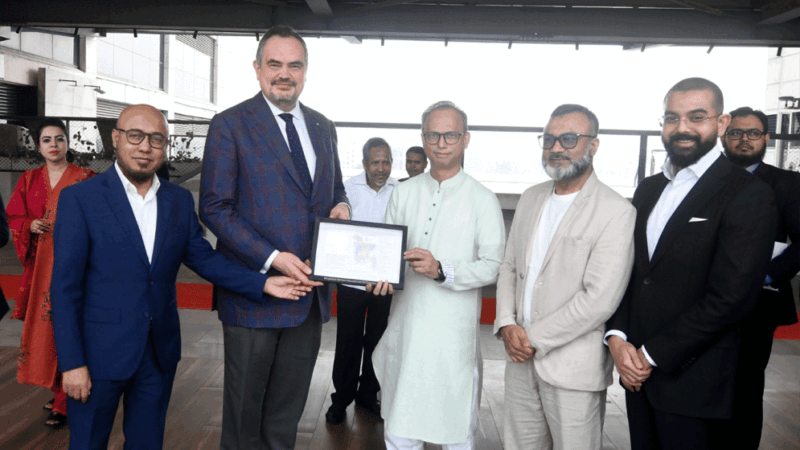
US Ambassador to Bangladesh Brent T Christensen held a high-level meeting with Bangladesh Garment Manufacturers and Exporters Association (BGMEA) President Mahmud Hasan Khan and members of its board of directors to discuss bilateral trade, investment and labour issues.
The meeting took place on Sunday at the BGMEA complex in Uttara in the capital, said a press release.
Discussions focused on various aspects of Bangladesh–United States bilateral trade, potential US investment in Bangladesh’s energy sector, labour-related matters and ways to expand economic cooperation between the two countries.
The US delegation included Labour Attaché Leena Khan, Agri Attaché Erin Covert, Commercial Attaché Paul Frost, Political and Economic Officer Srini Sitaram and labour affairs specialist Saifuzzaman Mehrab.
The BGMEA delegation was led by President Mahmud Hasan Khan and included Senior Vice-President Enamul Haque Khan, Vice-Presidents Md Reazwan Selim, Mizanur Rahman, Vidiya Amrit Khan and Md Shihab Uddoja Chowdhury, along with several BGMEA directors and former director ANM Saif Uddin.
During the meeting, BGMEA requested clarification on a proposed mechanism for duty benefits on garments manufactured using US cotton. Mahmud Hasan Khan said such an initiative could further strengthen cooperation between the textile and apparel sectors of the two countries.
In response, Christensen said the issue is currently being examined by the Office of the United States Trade Representative. He noted that the recent trade arrangement is positive for Bangladesh and that Bangladesh is the first country to receive this particular opportunity.
He also expressed hope that the initiative would increase cotton exports from the United States to Bangladesh.
BGMEA Senior Vice-President Enamul Haque Khan also raised concerns about business uncertainty caused by frequent tariff changes in recent times. The ambassador explained that the situation arose following a recent ruling by the Supreme Court of the United States and expressed hope that the issue would be resolved soon, restoring stability in tariff policies.
The BGMEA president also highlighted the importance of US investment in Bangladesh’s energy sector to meet the growing demand of the country’s expanding industrial base. He said investment in liquefied natural gas infrastructure could serve as a short-term solution, while US technology and investment in domestic gas exploration could address long-term energy challenges.
Ambassador Christensen responded positively, noting that US investors would be interested in entering the sector if Bangladesh establishes a long-term and stable energy policy.
The meeting also discussed labour law reforms and a proposed labour ordinance. The ambassador said labour sector reforms remain a long-standing and important issue in Bangladesh–US trade relations.
BGMEA said discussions are ongoing regarding 145 specific points in the proposed ordinance and that further clarification is needed on certain issues to ensure transparency.
BGMEA also proposed easing visa bond requirements and granting long-term visas for garment sector entrepreneurs.
During the discussion, BGMEA Director Sheikh Hossain Mohammad Mostafiz highlighted that Bangladesh has the highest number of LEED-certified green garment factories in the world under the US Green Building Council.
He said the United States could play a greater role in supporting sustainable development in the sector.
In response, the ambassador suggested engaging US brands and buyer companies more closely to help achieve this goal.
Senior BGMEA officials and representatives of the US Embassy also attended the meeting. Both sides expressed optimism about taking Bangladesh–US economic relations to new heights.